
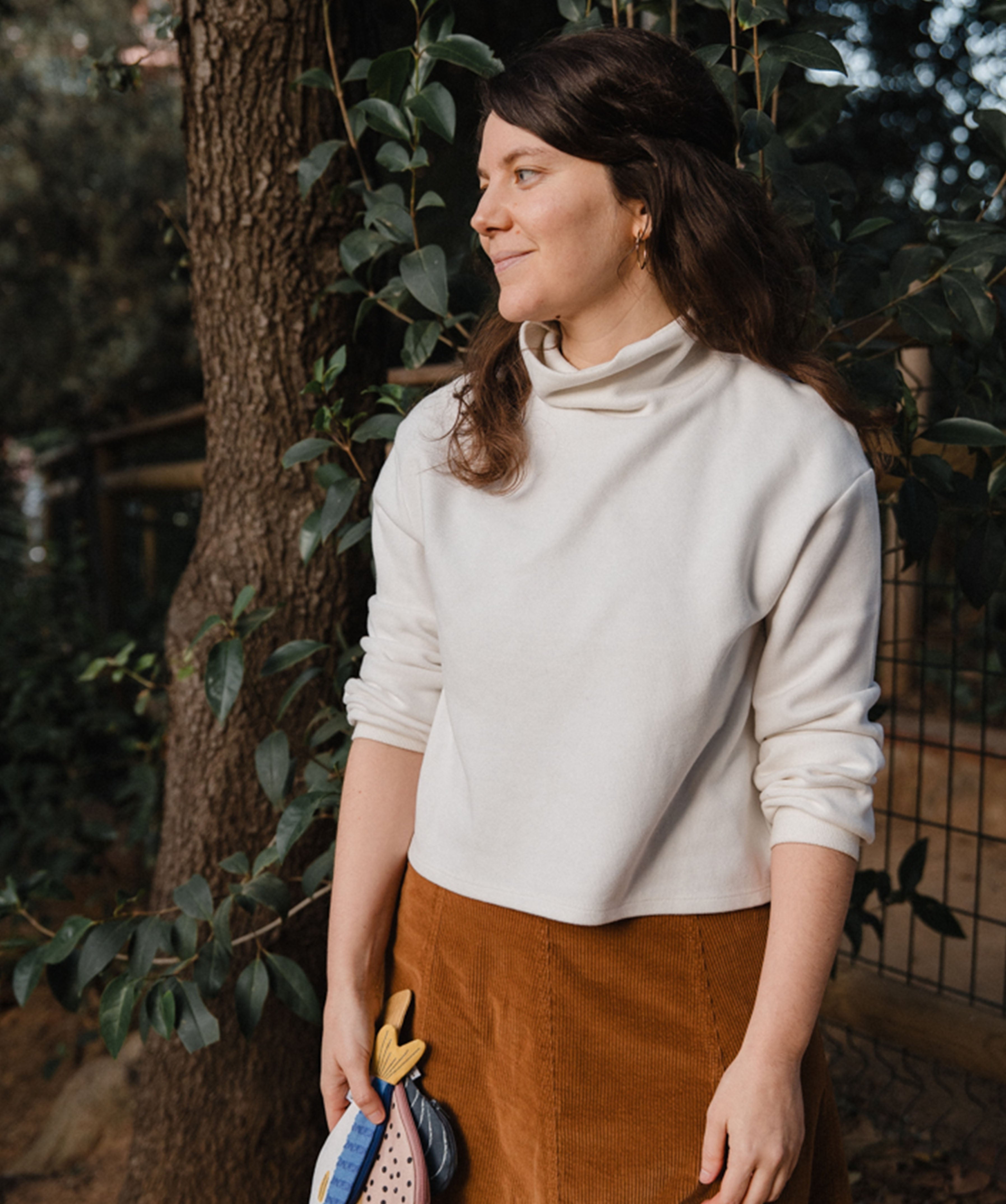
Inspiring Women – Clara Sáez: Imagination, Play and the Art of Bringing Everyday Life to Life
We are excited to begin this conversation with Clara Sáez, a multidisciplinary artist whose work spans drawing, ceramics, and theatre. Through characters, shapes, and colours, Clara constructs a playful and sensitive universe where imagination, play, and intuition play a central role. To begin, we would like her to tell us how she began exploring different disciplines and what captivated her about these diverse forms of expression.
When I draw, I sit in a quiet, safe space that brings me peace. Drawing gives me the freedom to invent and suggest whatever I want and, above all, to make visible what I imagine in the moment. For me, drawing is a dialogue with my intuition (or my ideas), and the line that defines and takes shape on the paper is an intimate dialogue. I suppose I discovered this when I was little, not with these words or these concepts, but with the feeling of enjoying myself inventing and transforming the white surface of the paper into whatever I wanted.
When I was little, I also went to a craft workshop, and I remember that we had complete freedom to play with different materials and create whatever we wanted. I made a boat out of cardboard, a clothes shop out of painted wood and plasticine, and some paintings using rollers to create textures and mix colours... I began to accumulate positive experiences with creating things with my own hands and to see the possible artistic transformations.
Theatre and music were other disciplines that caught my attention when I was little; I remember going to see Peter and the Wolf at the Liceu, where they used light puppets that were phosphorescent, and all that magic happening on stage fascinated me. It's actually another place where many things can happen. I also studied music from the age of seven, played in an orchestra, and all these sensations and experiences with the arts confirmed to me that creating, whether using sound, my hands or colours, transported me to pleasant places.
In fact, there are two films that I loved as a child and later understood why I liked them so much: Tic-Tac by Rosa Vergés, because it mixes different disciplines in the film, creating zooms in and zooms out on objects, where the inside of a clock or a fish tank can become a stage and the characters dance inside. I also loved James and the Giant Peach, because suddenly the drawings had three-dimensionality and the animals talked and had funny personalities.

Your works are full of playful little characters: walking stars, smiling suns, with a vivid colour palette. What or who inspires you? What feeds this special universe so full of joy?
It's true that I like to draw faces on leaves, objects, mountains... it's a way of personifying them and giving soul to elements that (apparently) lack it. In a way, it's like bringing that element, let's say a mountain, to life and making it more present in the drawing; in addition to being the setting or an element of the landscape, it becomes a protagonist, a secretive being that bears witness to the drawing.
I also like to make the eyes look straight ahead to engage the person looking at the drawing, to make them realise that a mountain is looking at them. I'm not quite sure why I do this, but I suspect it stems from this influence and attraction to the world of fantasy and imagination and, now that I think about it more carefully, perhaps animating objects or elements is a strategy to feel more accompanied.

You create two-dimensional illustrations and then move on to clay and ceramics, to volume. How does your creative process change when you modify the material? Do you feel that these disciplines 'dialogue' with each other?
I love modelling clay or making a clay slab and cutting out a shape. And, based on that shape, which is sometimes difficult to control, I improvise and adapt to the volume that has emerged. In other words, the design is totally linked to the volumetric shape of the cup, the mountain or whatever piece I am making. It is more interesting to take advantage of the imperfections, the small bumps, a slight hollow... that the clay piece may have than to try to draw what you had in mind at all costs.
In fact, I enjoy myself most when I do just that, taking the risk of drawing on the biscuit whatever its shapes inspire me to draw, without caring about the result, just being present in the drawing and enjoying the combination of colours, creating a play between the elements... When I'm drawing, I tell myself a story inside my head, finding similarities between the elements I place or looking for reasons why I'm drawing them, what they're doing there, and when the story comes to me, that piece already has meaning for me and is on its way to being finished.
This is how the collection of 'Good morning' and 'Good night' cups and plates came about. A collection of pieces featuring invented fauna and flora designs to help you start the day with energy or end it peacefully.

We love your acting and your work with @projecteiglu. How does your theatre and performance experience influence your visual art? Do you see that theatrical narrative appearing in your drawings?
When you draw a character, you are actually also doing an exercise in theatre, mimicry and empathy, as you put yourself in the character's shoes in order to capture in strokes and shapes the feeling that the character is experiencing. Or when I draw a river, for example, I think about a river, I try to hear it, feel it, connect with an image of a river, and I suppose that, in some way, my hand and pencil channel that feeling and it ends up being transformed into an intervention on paper.
In the show El lloc del desig (The Place of Desire) by projecte I.G.L.U., together with actress Maria Jover, we create visual and sound imagery and invite the audience to join us in this imaginary world, feeling, listening... And, of course, to get into character, what I do is visualise and feel that what I imagine is true and pretend that the imaginary is tangible and real. It's the same as in drawing, but instead of leaving a trace on paper, I show it with my body, my gaze and my expression; suddenly, I become the character I have drawn.

We have also seen that you organise drawing workshops. What do you enjoy most about teaching and sharing your process with others?
I have always been involved in educational projects; as a teenager, I was part of a youth club. I also taught art classes in secondary school for a few years. In 2014, together with illustrator Julia Abalde, we created Pin Tam Pon, a printing project for children that allowed us to hold workshops in museums, art centres, libraries and cultural centres across the peninsula. We also published the book Tris, Tras!, which is full of stories, games and art activities.
Currently, I coordinate and teach classes in a Specialisation Course in Illustration, where the students are adults and are very excited to learn this discipline. I really enjoy seeing the students' processes and their evolution, commenting on their decisions and, above all, showing them which ones work. I also love that each student takes the project into their own territory and you can discover the person through how they visually develop their proposal.

What kind of emotions or messages do you hope people will experience with your art? Whether it's a print, a mug, or a piece of pottery.
I would like the people who own one of my pieces, whether it be an illustration, risograph print or ceramic, to be transported to a pleasant place, somewhere that makes them feel good. I suppose it depends on the drawing, but as these pieces and drawings generally come from a very personal place, when someone buys them or shows an interest in them, I think that, in some way, they are sharing a piece of that place with me.

To other creative people like you, what advice would you give them to start combining disciplines that appeal to them, even if they don't really know where to begin?
Overcome your fear of trying new things and, above all, enjoy the process and the experience. In reality, we have more strategies and resources stored away than we ourselves realise, and when the opportunity arises, they come to the fore and surprise you.

In the near future, what projects, collaborations or new creative territories would you like to explore?
Well, with Project I.G.L.U., we are going to start a new creative process to create La pedra que cau a l’aigua (The Stone that Falls into the Water), which will be a new show where we will talk about the infinite possibilities offered by the imagination, and I am especially excited to create it. I also have some publishing projects that will be coming out, and I would like to continue exploring ceramics and large-format drawing.

We are very grateful to have had the opportunity to delve into Clara's creative universe and the reflections that permeate her work. Her way of understanding art as a space for play, intuition and connection, as well as her ability to bring everyday life to life through characters, forms and stories, is deeply inspiring. We are excited to accompany her and discover how her creative language continues to expand in the coming chapters.
To our readers, we encourage you to follow Clara on Instagram and keep an eye out for their upcoming projects. Without a doubt, there are still many stories left to imagine.
Interview conducted by Agostino Lo nardo, part of Don Fisher's crew

Leave a comment
This site is protected by hCaptcha and the hCaptcha Privacy Policy and Terms of Service apply.