
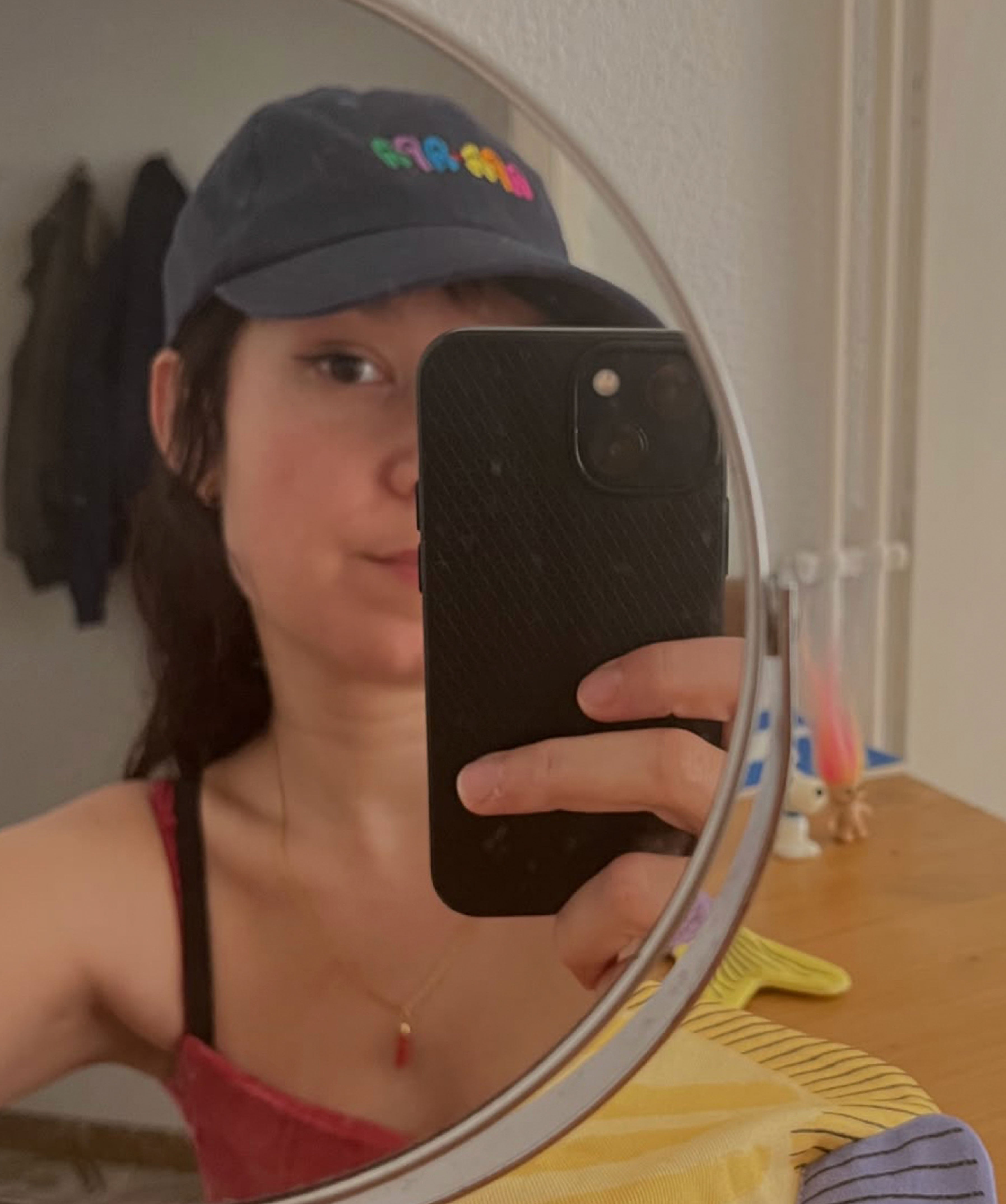
Inspiring Women – María Ramos: Fairy Tales, Forest Creatures And The Art Of Wonder
Today, Captain Don Fisher's boat sails towards a universe full of gentle creatures, silent forests and small scenes where fantasy seems to live alongside the everyday. We're absolutely delighted to welcome María Ramos, an illustrator and author capable of turning mushrooms, flowers, rabbits and tiny characters into warm, deeply sensitive stories.
María, your work carries a very special sensitivity, as if every illustration hid a little story or a memory. We'd love to go back to the very beginning with you: how was your bond with illustration born, and at what point did you feel that this creative world could become your path?
I've always loved drawing. As a child I used to make little comics; I remember having a book that taught you, step by step, how to draw characters. I spent a huge amount of time at home drawing and copying those pictures, in fact, it was one of my favourite ways to play.
Although I later studied science, when the time came to choose my professional path I decided to study Fine Arts. There I discovered many disciplines and more technical approaches, but there was one subject in particular, Illustration, that especially caught my interest. That was when I realised that, beyond enjoying drawing, what I was really passionate about was telling stories.
I think that was the moment I saw it clearly: I wanted to devote myself to illustration. I understood that I could bring together the two things I loved most, drawing and narrative, and tell little stories through images.
Your book Tres Luces (Three Lights) has received incredible recognition, being selected among the best in the world in Bologna and compared to universes as magical as those of Hayao Miyazaki and Tove Jansson. What did it mean for you to create this story and to discover that it had connected so deeply with so many readers?
When I first started imagining this story, I actually pictured it as a picture book. But as I developed the plot, I realised it needed more room to grow and that it had a more classic novel structure. I talked it over with my editor and she encouraged me to try this format.
It was the first time I'd done anything like it, and I was so focused on the book that I never really stopped to think about whether it would work or not. I simply enjoyed the process.
That's why the response it received was such a lovely surprise, and it still is today. It moves me a great deal when a child, or their family, writes to tell me about the relationship they've built with the story. One of the things I most love hearing is that, even though it might seem like a long book for certain readers at first glance, they find a way to step into it and enjoy it. The fact that it's divided into chapters helps them move forward little by little without it feeling too heavy.
It also helped me question some preconceived ideas about what supposedly suits each age. Sometimes it feels like everything is very neatly categorised, but readers always surprise you. This book taught me that it's worth trusting the story you want to tell and not letting yourself be too limited by labels or established formats.
Your illustrations are constantly filled with small, endearing characters and creatures: frogs, rabbits, caterpillars, gnomes or mushrooms that seem to have a life of their own. Where does this fascination with building such tender, imagination-filled worlds come from?
As a child I loved inventing stories and imagining that little hidden worlds could exist within our own. I don't think I've entirely lost that way of looking at things. Fantasy lets you talk about complex things in a simpler, more approachable way.
Right now, on top of that, I'm getting closer and closer to the world of fairy tales in the projects I'm working on. It's a place I've reached gradually, after many years of making picture books, and it's something I'm exploring.
Nature seems to be very present in everything you do: landscapes, flowers, forests, the sea, or small details found on a walk. What role does the natural world play within your creative and emotional process?
I think it comes from nature itself, which has always been very present in my life. My family keeps animals and, ever since I was little, I've been deeply connected to the countryside. I watched how my grandmother made cheese, how the cows and sheep were fed, or how the hens' eggs were collected. These are memories that show up a lot in my stories.
Even though you work in very different formats, from picture books to more editorial projects or commercial collaborations, your visual universe always feels coherent and recognisable. How do you manage to keep such a personal identity in each project?
Honestly, I don't think too much about maintaining a specific identity. I think I simply draw the things I like and that interest me, and in the end that creates a certain continuity from one project to the next.
I'm also lucky enough to spend a lot of time on personal projects, which are the ones that most shape the way I work. And when I take on collaborations or commissions, people usually come to me precisely because of that earlier work. The references they give me are my own illustrations. So even when I'm working for someone else or in a different context, I don't feel I have to become another person or work in a completely different way. I can keep doing things fairly naturally.

Beyond illustrating, you also lead writing workshops for illustrators, as well as "magical drawing" workshops. What do you most enjoy about sharing your creative process with other people?
Besides the workshops, I spent five years teaching on the Illustration degree in Madrid, and one of the things I learned during that time is that teaching also forces you to keep learning. When you have to explain something, you have to reflect on your own process, do some research, and ask yourself why you do things in a particular way.
But at the same time, I've never understood classes or workshops as something where one person talks and everyone else listens. For me it's always been more of a dialogue. In fact, I've learned an enormous amount from students and from the people who take part in the workshops.
What I enjoy most is accompanying someone as they develop their personal project, acting more like a mentor. I'm more interested in guiding or asking questions than in telling someone what they have to do. I think each person has a different way of telling stories, and the beautiful thing is helping them find it.
And then there's the atmosphere that's created. Drawing tends to be a fairly solitary activity, so bringing together several people with the same urge to create generates a very special energy. Even if it's only for a few hours, you leave with more desire to draw and to keep working on your own projects.

Your illustrations have something very spontaneous and free about them, yet at the same time they reveal a great deal of sensitivity and detail. What is your working process usually like? Do you tend to combine traditional and digital techniques in an intuitive way?
It's funny, because a lot of people tell me my drawings look very spontaneous and that I must draw very fast, but in reality I'm quite slow. I have a very loose line, but I repeat the drawings and the strokes over and over until I find something that convinces me. I couldn't quite explain what it is, but there's a moment when I feel the image is working. And if that moment doesn't come, I keep drawing and trying.
Over the years I have gained agility and I find the compositions or figures I'm looking for more quickly, but the process is still fairly similar.
As for techniques, it depends a lot on the project. My latest books are made entirely with traditional techniques, mostly alcohol markers. Now, for the next project, I'm going to try mixing them with watercolour, coloured pencils or pastel to see what happens.
I've also worked combining hand-drawing with digital tools. The line is always drawn by hand. Then I scan it and put everything together in Photoshop, almost as if I were making a collage, using real textures and scanned card. It's a way of working based on masses of colour and composition.
Every book, every project, is a little school. You always end up learning something that you carry over to the next one. For example, with some of my books I learned a great deal about composition and colour, and those are things that still stay with me today whenever I start something new.

And to close our journey with you, María: what would you say to those who are just starting out in the world of illustration and are still searching for a voice of their own amid all the creative noise that exists today?
I'd tell them to try not to worry too much about doing what they're supposed to do.
When I started out, the kind of drawing I did wasn't what you saw most in children's publishing back then, and I thought it would be very hard to get published. But I kept drawing the things I liked, making fanzines, going to self-publishing festivals and sharing work with other illustrators, doing collective projects. Meeting people matters, because you realise there isn't a single way of doing things and that many of the doubts you have are shared by everyone.
I also think it's good to allow yourself to change. Sometimes you start out thinking you want one thing and that the goal is set in stone, and then you discover you're drawn to something else. That's perfectly fine.
And not much more than that: draw a lot, make the things you feel like making, surround yourself with people who share your interests, and enjoy it as much as possible. It might sound silly, but I think it's rather important.
We're deeply grateful to have been able to step into María's quiet, imaginative universe and into the reflections that run beneath her work. The way she trusts each story above any label or format, her patience in repeating a line until it simply feels right, and her gift for turning a mushroom, a frog or a childhood memory of her grandmother's countryside into something genuinely tender make her work profoundly inspiring. We can't wait to see where this new drift towards fairy tales takes her next.
To our readers, we encourage you to follow María on Instagram and to keep an eye on her upcoming projects. There are, without a doubt, many more little worlds still waiting to be imagined.
Interview conducted by Agostino Lo nardo, part of Don Fisher’s crew.


Leave a comment
This site is protected by hCaptcha and the hCaptcha Privacy Policy and Terms of Service apply.